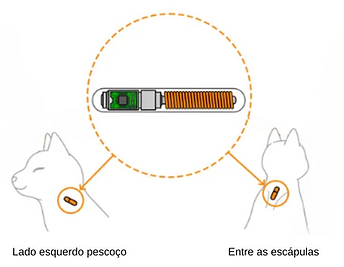
Microchip
The microchip is a tiny capsule implanted under the animal's skin in a painless way.
Contrary to what some people think, a microchip doesn't work like a radar or GPS. It carries a unique number that identifies the animal in a database. This number can be read using a microchip reader that veterinarians usually have.
In the database where your cat's microchip number is registered, it will be possible to find all its data, such as name, address, vaccinations, and more. Therefore, if your cat gets lost and whoever finds it wants to return it, they only need to search for the chip number in the database. For this reason, it is very important that the cat is registered in the database. We suggest SIRAA.
What is a transponder (microchip)? What does it look like? What are its main characteristics?
A: Commonly known as a microchip, it is an electronic microcircuit consisting of a unique and unalterable code, encapsulated in surgical bioglass and, in the case of Microchip Partners, coated with a biocompatible anti-migration substance for use in animals.
Why adopt microchipping for animal identification?
A: Microchipping is a secure, tamper-proof, and permanent identification method that guarantees the animal's identification. It also simplifies the breeder's work by preventing confusion between litters, facilitates the veterinarian's access to the animal's data online, and makes it easier to rescue the dog if it gets lost or stolen, among hundreds of other advantages. The microchip serves as proof that a particular dog is indeed the dog in question. In several countries, the use of this method is mandatory for identifying all pets/companion animals. It's a natural trend that only brings benefits to the sector and the population in general.
What is the ideal microchip size for use in dogs?
A: The smallest one is approximately the size of a grain of rice, measuring 12mm x 2mm. Currently, there is no microchip smaller than 12x2mm approved for use in animals.
How long does a microchip last?
A: The microchip does not have a battery and remains inactive most of the time, only being powered when it receives a signal from the reader. After application, it remains with the animal for its entire life. It provides its unique number every time it is scanned by the reader, sending its code which is displayed on the reader's screen, making it possible to send the information to a computer. Since the microchip does not contain a battery, there is nothing to wear out. Its durability is the time it takes for the bioglass to decompose, that is, more than 100 years.
Why use only microchips and readers that comply with the international standards ISO11784 and ISO11785?
A: These international standards were developed to regulate the use of microchips in animals, determining the type, controlling the unique numbering of the microchip, and enabling the animal to be identified anywhere in the world by reading the microchip with any reader that meets the standards.
How is the microchip implanted in the animal? A: Its small size and shape allow it to be injected into the animal with a special syringe similar to those used for vaccine injections, making the procedure painless.
In summary, the steps for implantation are as follows:
1. Scan the animal to check if there is already a microchip implanted;
2. Scan the microchip to verify that the number is correct;
3. The microchip should be applied to the back between the shoulder blades;
4. Use your hand to feel the implantation site;
5. Disinfect the skin at the implantation site using an alcohol-soaked cotton swab;
6. With one hand, lift the animal's skin at the implantation site;
7. Insert the needle at a 45° angle with the syringe plunger pointing upwards;
8. Quickly push the syringe plunger all the way down and remove the needle; 9. Scan the area to ensure the microchip can be read.
Who can perform the microchip implantation?
A: Microchip implantation must be performed exclusively by a veterinarian.
Does microchip implantation harm the animal?
A: Although the microchip applicator needle has a slightly larger diameter than a vaccine applicator needle, animals react in the SAME way, making the procedure painless. The microchip is completely biocompatible and harmless to the animal's health.
Does the animal need to be sedated to receive the microchip?
A: No! Injecting a microchip is a procedure similar to administering a regular injection.
Anesthetizing the animal is not required and is not recommended. Is it possible for the animal to be allergic to the microchip?
A: The microchip is inert, smooth, and biocompatible. There is virtually no possibility of developing an allergic reaction or rejection of the microchip after it has been correctly injected into the animal.
Can the microchip move inside the animal's body?
A: When implanted correctly and if a microchip with an anti-migration coating is used, a thin layer of connective tissue forms around the microchip, preventing its migration.
What is the best age to microchip dogs? A: Microchipping can be done as early as 10 days old, but generally it is done along with the third dose of the multivalent vaccine, that is, at 3 months of age.
Source: Microchip Partners